
2025
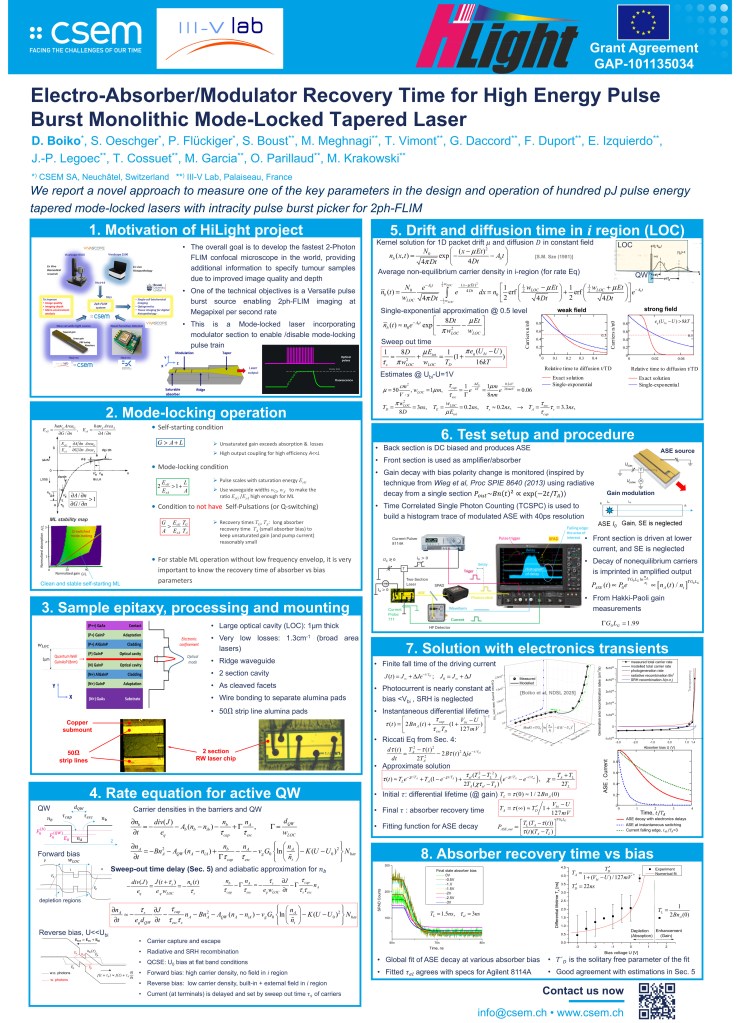
- 23rd-27th June. “Electro-Absorber/Modulator Recovery Time for High Energy Pulse Burst Monolithic Mode-Locked Tapered Laser” CLEO/Europe-EQEC 2025 conference series – International Congress Center of Messe, Munich, Germany. D. Boiko, S. Oeschger, P. Flückiger, S. Boust, M. Meghnagi, T. Vimont, G. Daccord, F. Duport, E. Izquierdo, J.-P. Legoec, T. Cossuet, M. Garcia, O. Parillaud, M. Krakowski (CSEM)

- 16th-18th June. “200pJ pulse energy monolithic mode locking in GaInAs/GaInAsP vs GaInAsP/GaInP QW systems” NDSL 2025: Nonlinear Dynamics in Semiconductor Lasers workshop – Weierstrass Institute, Berlin, Germany. D. Boiko1, S. Oeschger1, P. Flückiger1, S. Boust2, M. Meghnagi2, T. Vimont2, G. Daccord2, F. Duport2, E. Izquierdo2, J-P Legoec2, A. Elias, M2. Garcia2, O. Parillaud2, M. Krakowski2 (1. CSEM, 2. III-V lab)
“Mode locked (ML) high pulse energy (~200pJ) tapered lasers emitting 3-6 GHz pulse trains in of a few ps width hold a promise to find numerous applications such as two-photon absorption excitation of fluorescence for time resolve measurements, two-photon polymerization or driving THz photoconductive antennas. Monolithic lasers with that high pulse energy were pioneered by CSEM and III-V Llab [1] and later were also demonstrated by FBH [2] utilizing different QW compositions, with cavities of 6 to 13 mm long. In this communication, we compare analytical solutions of Haus-New master equation for tapered ML lasers realized in very different material systems of GaInAs/GaInAsP and GaInAsP/GaInP QWs and, respectively, emitting at 980 or 905 nm wavelength (projects MLSCL and HiLight). The difference originates from the gain, cavity dispersion and length. Interestingly, while 13 mm long GaInAs/GaInAsP lasers follow a classical picture of ML when low frequency envelope can be avoided and a stable ML can be reached with the pump current, the 6 mm long GaInAsP/GaInP lasers are capable of high pulse energy ML in a narrow range of parameters. Moreover, they reveal very unexpected behavior in function of the gain bandwidth, gain compression, cavity losses and absorber bias. At the same time, for both designs, the output pulse energy scales in the same direction in function of the number of QWs, phase-amplitude coupling (Henry’s factor), taper angle, largeangle, large optical cavity and ridge waveguide widths. These findings will simplify future designs of such lasers.
[1] M. Krakowski, P. Resneau, M. Garcia, E. Vinet, Y. Robert, O. Parillaud, B. Gerard, S. Kundermann, N. Torcheboeuf, D. L. Boiko, IEEE J. Sel. Topics Quantum Electron., 25, 1100615 (2019).
[2] S. Wohlfeil, H. Christopher, J. Fricke, H. Wenzel, A. Knigge, and G. Tränkle, Electron. Lett., 59, e12736 (2023). “
- 16th-18th June. “Self-confident light-current-voltage analytical model for QW saturable electroabsorber in a ridge waveguide laser structure” NDSL 2025: Nonlinear Dynamics in Semiconductor Lasers workshop – Weierstrass Institute, Berlin, Germany. D. Boiko1, S. Oeschger1, P. Flückiger1, S. Boust2, M. Meghnagi2, T. Vimont2, G. Daccord2, F. Duport2, E. Izquierdo2, J-P Legoec2, A. Elias, M2. Garcia2, O. Parillaud2, M. Krakowski2 (1. CSEM, 2. III-V lab)
“Monolithic mode-locked lasers with 200pJ pulse energy were pioneered by CSEM and III-V Lab [1] and later were also demonstrated by FBH [2]. The design of such lasers greatly simplifies if there is an adequate analytical description for the saturable electro-absorber. In this communication, we report on such a simple and self-consistent light-current-voltage model. Previously, self-consistent model was proposed by Ryvkin et al [3] for SESAM. However, as opposed to the Quantum Confined Stark effect (QCSE), it is based on Franz-Keldysh effect in a bulk semiconductor and represents SESAM’s p-i-n heterostructure as a capacitor in an open external circuit. It does not account for the absorber bleaching and the carrier transport. Here, we report a complete analytical LIV model that accounts for the QCSE, SRH and radiative recombination in the QWs, carrier capture and escape to the barriers, carrier drift and diffusion in the i region, built-in barrier due to depletion. The model was verified in experimental Hakki-Paoli gain measurements, absorber recovery time measurements utilizing time-correlated single photon counting as well as the IV curve measured at the absorber terminals in a two section ridge waveguide GaInAsP/GaInP lasers. Good agreement was reached. In particular, the exitonic absorption seen in the gain spectrum at -3V bias and indicating flat band operating conditions of QW well agrees with extracted corrections due to QCSE energy shift of the absorption edge with the bias.
[1] M. Krakowski, P. Resneau, M. Garcia, E. Vinet, Y. Robert, O. Parillaud, B. Gerard, S. Kundermann, N. Torcheboeuf, D. L. Boiko, IEEE J. Sel. Topics Quantum Electron., 25, 1100615 (2019).
[2] S. Wohlfeil, H. Christopher, J. Fricke, H. Wenzel, A. Knigge, and G. Tränkle, Electron. Lett., 59, e12736 (2023).
[3] B. S. Ryvkin, K. Panajotov, and E. A. Avrutin, J. Appl. Phys. 103, 103102 (2008)“
- 7th May. “Fast FLIM application and preview of the Digital Twin model” FLIMposium Workshop – Brunel University London, UK.
- 23rd-25th January. “Presentation of HILIGHT, laser specifications o first results on HILIGHT lasers” SPIE Photonics West 2025, Industry Events, San Francisco, USA. (III-V lab)
2024
- 17th-22nd November. Presentation of SPAD devices (poster) and SPAD arrays (talk) for microscopy applications. Single Photon Workshop (SPW) 2024, The Exchange, Edinburgh, UK. (FBK)
- 25th September. “Highly integrated versatile laser source enabling two-photon excitation in digital diagnostics and biomedical research” European Academy of Dermatology and Venereology (Amsterdam, The Netherlands) Philipp Andre (Vivascope)

- 20th September. “How To Build A Monolithically Mode-locked 200 pJ Laser Enabling Two Photon Excitation Time-resolved Fluorescence Imaging At 8 Megapixels Per Second?” European Semiconductor Laser Workshop 2024 (Kassel, Germany). D Boiko, S Oeschger, N Torcheboeuf, S Boust, F Duport, M Garcia, N Böhm, Z Baltzer, A Esposito, A Tontini, L Gasparini, P Flückiger, A Rauschmayr, P Andre, M Krakowski (CSEM)
“We redesign our monolithically mode-locked tapered MLSCL laser build for ESA (200 pJ pulse @ 3 GHz reprate, [JSTQE 2019]) for novel application in a confocal laser scanning microscope (CLSM) with world record pixel acquisition rate of 8 Mpx/s and subcellular tissue resolution. The laser will enable two photon excitation time-resolved fluorescence imaging. Laser requirements are established by deep analysis of the existing hardware VivaScope 2500 ex-vivo CLSM which so far operated with two CW lasers on fluorescence intensity and tissue reflectance imaging channels, respectively, and have already revolutionized the work of pathologist delivering digital H&E-like staining images in tens of seconds. With partners of Highlight project we are targeting to introduce additional two photon excitation fluorescence lifetime imaging channel and improve the tissue penetration depth while preserving the lateral resolution and image pixel acquisition rate. Carefully modelling the laser pulse parameters, two photon absorption and fluorescence decay processes, image quantization and Poisson noising at low fluorescence photon numbers, the time-resolved fluorescence images with 52 ns pixel dwell time is shown to be possible with the image SNR of 10. To achieve this the monolithic laser composed of tapered and straight WG gain sections as well as an absorber section will additionally incorporate a built in pulse burst picker section enabling to produce 15ns duration bursts of Mode-locked pulses. Fluorescence waveforms will be acquired with time gated SPAD array detecting both fluorescence growth and decay process for extracting the lifetime at the highest SNR ratio.”
- 20th September. “New versatile and compact laser source for short pulse trains at 900 nm for 2ph-FLIM” European Semiconductor Laser Workshop 2024 (Kassel, Germany). S Boust, M Meghnagi, G Daccord, F Duport, E Izquierdo, J Legoec, M Garcia, O Parillaud, D Boiko, M Krakowski (III-V lab)
“We first present the concept of a new laser source developed in the Horizon Europe HILIGHT project (“Highly Integrated Versatile Laser Source enabling two-photon excitation in digital diagnostics and biomedical research”). This compact source based on a tapered laser diode monolithically integrating several functions will address applications based on two-photon excitation fluorescence lifetime imaging microscopy (2ph-FLIM). This process has two phases: i) a train of pulses excites the dye; ii) the laser is turned off to measure the fluorescence decay. This involves being able to precisely modulate the laser to move from one phase to another. The choice of acridine orange dye requires the choice of wavelength around 880nm-900nm. This source will ultimately be used in two specific use cases: i) instant digital histopathology and ii) biomedical research in the context of cancer diagnosis.
We propose a monolithic mode-locked tapered laser diode producing on-demand 10ps pulse trains at 6GHz, with high peak power (>20W). This source will also be agile: the pulse train can be emitted and turned off (On/Off switching) in less than 0.3 ns. We then present the results obtained on two constituent elements of this laser: two-section laser diode with saturable absorber and tapered laser diode. They allow the design of the HILIGHT laser source and show operations in line with the desired objectives.”
- 3rd September. “Multi-colour FLIM for a single-cell biology of cell fate” Photon 2024 (Swansea, UK). A Esposito (Brunel University London).
“Cellular decisions—for instance, those inherent in cell fate determination (proliferation, differentiation, cell death), cell cycle regulation (commitment to the cell cycle, cell cycle checkpoints) or cell migration—are the outcome of the activity of complex biochemical networks processing information from the extracellular milieu and the intracellular compartments. Notably, most cellular decisions exhibit significant cell-to-cell variability caused by non-genetic determinants: in the face of an identical stimulus, non-genetic heterogeneity can manifest itself as broad distributions in the timing at which individual cells respond to the stimulus. Data commonly used for systems biology approaches, often gathered by high-throughput methodologies such as genomics, transcriptomics and proteomics, need to be complemented by high quality biochemical data, possibly acquired at single cell resolution and capturing the dynamics of biochemical networks and phenotypes, in order to better resolve biochemical complexity at the cellular level. We have developed a number of technology platforms based on multi- or hyper- spectral FLIM and novel FRET pairs dedicated to biochemical multiplexing. With these techniques, we aim to perform perturbation analysis of biochemical networks in living cells and to correlate network topologies and their heterogeneity with cellular decisions. Here, we will describe the development and application of multi-colour FLIM for the simultaneous measurement of three FRET-based biosensors and, more specifically, for the description of cascades of biochemical events within the living cells, the study of cellular heterogeneity in biochemical networks and cellular decisions. The integration of these sensing platforms with Optogenetics is now promising to enable the quantitative spatio-temporal control and read-out of biochemical reactions in the living cells, permitting a single-cell systems biology approach to the understanding of cellular decisions.”
- 1st July. “A novel compact and flexible 905nm laser for on-demand excitation pulse trains” Optique Rouen 2024 (France), Sylvain Boust and colleagues (III-V Lab)

- 24th March. “Imaging and control of live cell biochemistry by light-sheet microscopy”. Focus on Microscopy 2024 (Genoa, Italy), Alessandro Esposito (Brunel University London)
- 26-29th February. “Imaging live-cell biochemistry by light”. Talk and hands-on sessions on FLIM at the GERBI FLIM workshop 2024 (Munich, Germany), Alessandro Esposito (Brunel University London)
 HILIGHT