HILIGHT Detector Achieves Sub-Nanosecond Gating and Initial Imaging

The HILIGHT Project has reached a new stage in detector development, with recent tests confirming both advanced temporal performance and successful integration into a microscopy platform.

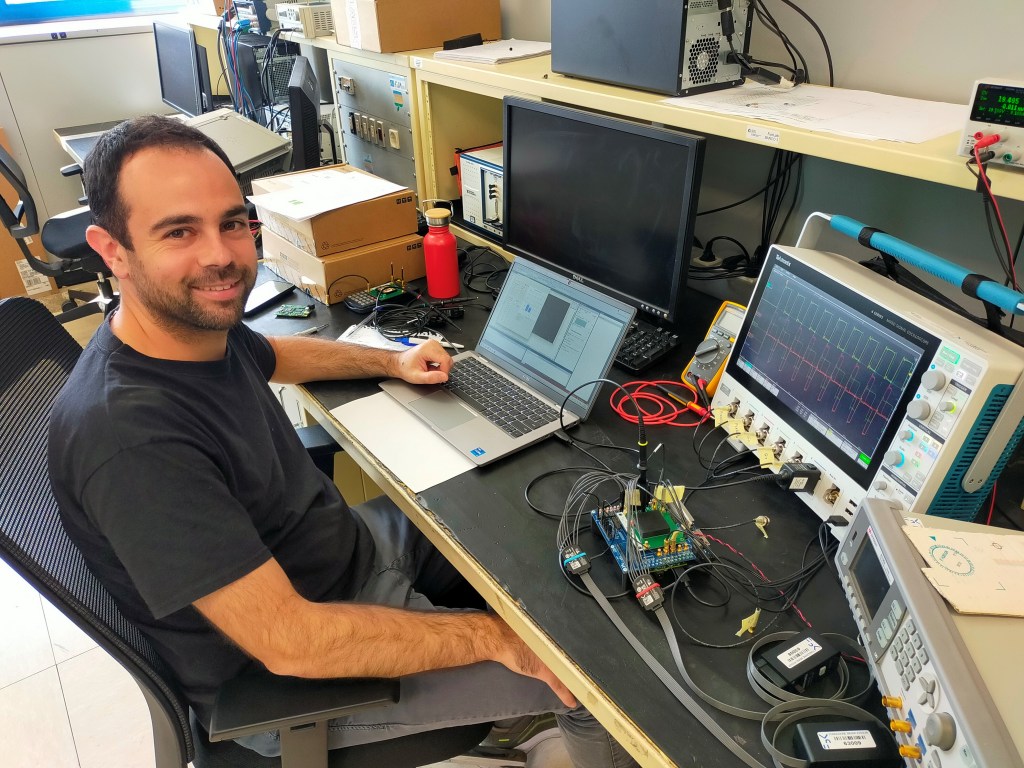
Recent experimental work has demonstrated two key advances in the performance and readiness of the HILIGHT detector. First, the minimum achievable gating window width has now been fully characterised, with measured values below 1 ns. This level of temporal control is essential for time-resolved measurements and supports the detector’s use in fluorescence lifetime imaging.

Second, the HILIGHT detector has been successfully coupled to a microscope, enabling the acquisition of the first images from a Convallaria majalis sample. At this stage, the images represent standard photon count measurements rather than fluorescence intensity or lifetime images. These measurements serve to validate optical coupling, alignment, and detector operation within a microscopy environment.

Together, these results mark an important step toward full system-level FLIM measurements. The first fluorescence lifetime images using the HILIGHT detector are expected as integration and testing progress.

We look forward to sharing further updates as detector validation and system integration continue across the HILIGHT consortium.

HILIGHT Project Update – First Laser Fabricated

We are pleased to announce another major milestone for the HILIGHT Project.


The first custom 905 nm multi-section laser has now been successfully fabricated and will undergo initial characterisation at III-V Lab in the coming weeks.

This laser has been purpose-built for two-photon fluorescence lifetime imaging (2ph-FLIM) and represents a key step toward achieving faster, higher-precision excitation which is essential for the HILIGHT’s goal of advancing digital, time-resolved microscopy for clinical and research use.

Following characterisation, the laser modules will be delivered to project partners for integration with the detectors fabricated at FBK and system testing at Brunel University London and VIVASCOPE.

This achievement marks another major step forward in the development of the complete HILIGHT confocal FLIM platform.

We look forward to sharing further progress as integration and system validation continue across the consortium.

Our version of a jeweler’s box – each tiny gold chip is a laser.

#HorizonEurope #HiLIGHT #III-VLab #CSEM #BUL #FBK #Vivasvope

HILIGHT Project Update – First Detector Fabricated and Under Test

We are pleased to report a major step forward for the HILIGHT project. The first HILIGHT detector has been fabricated at FBK, and is now undergoing initial testing with our colleagues Alessandro and Gianpietro.

This detector introduces a new approach to fluorescence lifetime imaging by delivering purely digital measurements at unprecedented speed. This capability is central to the HILIGHT confocal microscopy system, which aims to deliver faster, more accurate imaging for clinical and research applications.

The detectors will be delivered to Brunel University and VIVASCOPE, where they will be combined with laser sources designed by CSEM and fabricated by III-V Lab.

This integration marks the next phase of system development and testing. We will continue to share progress updates, publications, and upcoming events as the project advances.

#HorizonEurope #HiLIGHT #III-VLab #CSEM #BUL #FBK #Vivasvope