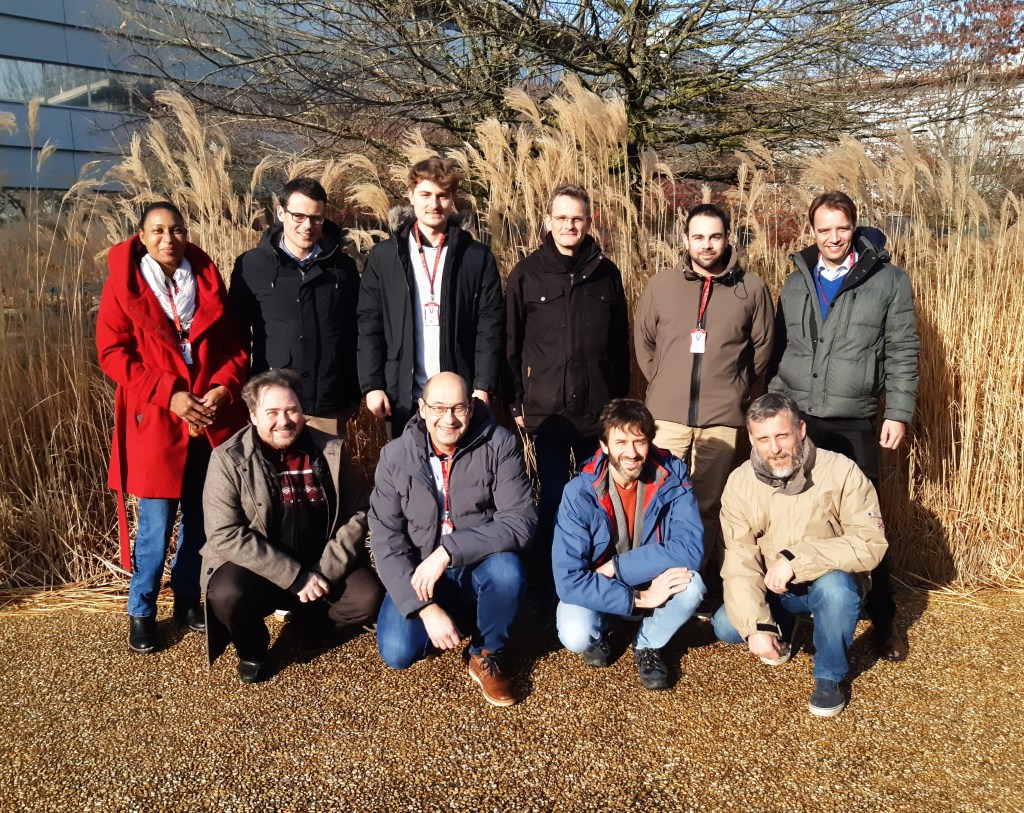
Innovating biophotonics… in beautiful Trento

8-9 April, HILIGHT’s third General Assembly meeting took place in the lovely city of Trento, Italy.

☑  Our consortium partners meet for collaborative discussions, thoroughly reviewing the project’s progress, addressing ongoing challenges, and thoughtfully outlining the strategy for the next phases.


A special thank you to our hosts, Leonardo Gasparini and Alessandro Tontini for organising the meeting and a delightful dinner at a local restaurant in the heart of Trento

🚀 We are eagerly looking forward to the next phase of the project, where we aim to test the first lasers for the future HiLIGHT microscope

#HorizonEurope #HiLIGHT #III-VLab #CSEM #BUL #FBK #Vivasvope

Kick-off time!

The EU HORIZON announced the success of our grant application in the summer of 2023. The HILIGHT consortium was thus formed in the autumn, and funding started on 1st December 2023. After the partners organized their work and started to deliver on preparatory tasks, on 17-18 January, we met in person for the first time for the HILIGHT kick-off meeting.

It was only appropriate for III-V Lab, the project coordinator, to host this meeting at their Palaiseau (France) site near Paris. Each partner presented their work packages, and we agreed on organizational structure, future meetings, and first steps, the usual things. It was also a great occasion to get to know each other as some of us never met in person but only through tens of meetings and the many emails exchanged during the pre-award stage. Also, it was great to tour the III-V Lab facilities, a major player in the fabrication and innovation of III/V semiconductors. We visited their impressive facilities with their large clean rooms, the reactors for epitaxial growth, and their people.

An exciting time for all of us, and we are looking forward to the first results we will share with the community. Watch this space.

HILIGHT branding – explainer

Logos and branding are certainly not the most important aspects of a project but they do create a sense of community and common goals and ultimately capture what a collaborative project is meant to achieve. Thus, let us explain our branding.

First of all, the name of the consortium: HILIGHT. Not a proper acronym as we have to borrow letters from the title of our grant proposal but a name that works. Its origin can be tracked from this title contraction:

Highly Integrated Versatile Laser Source enabling two-photon excitation in digital diagnostics and biomedical research.

You can also think about us developing semiconductor technologies for ultra-fast diagnostics, trying to highlight where cancer is in a tissue. Then you are a spelling error away from our name.


The font (impact) and the heavy inclination express our commitment for fast development of innovative semiconductor technologies to disrupt healthcare applications. The colour choice is to recall the near-infrared spectrum we are using to image samples.


We also wanted to integrate some graphical elements explaining our approach. The first step was to work in the dot of the first “i”. The dashed lines refer to our capabilities to shape bursts of high power high frequencies laser pulses to shape optimal excitation conditions for tissue imaging. The “decaying spectrum” illustrates our target to generate tissue contrast using fluorescence and quantifying fluorescence lifetimes.

When iterating the design, we decided to squeeze the HI of HILIGHT into a single element, after all… a highly integrated laser might require a highly integrated logo, doesn’t it?

All other versions of logos you will find in our website and documentation are based on those basic concepts.

Revolutionizing Healthcare: HILIGHT Consortium Receives €3.2 Million to Develop Instantaneous Digital Histopathology Technologies

Listen as a podcast on Spotify

A patient lies in the operating theatre surrounded by a medical team.  Armed with their experience, a surgeon is excising a tumour and decides how much tissue around the tumour should be removed. Be too conservative, and the probability of tumour reoccurrence increases; be too radical, and the patient’s quality of life might be compromised. The analysis of tissues to determine the type and precise location of disease (a medical discipline called histopathology) is critical to ensuring patients live longer and healthier lives. However, the current time constraints associated with obtaining actionable results often impede its use at the point of care and in intraoperative settings, leading to delayed decisions for disease management.

While advanced optical imaging technologies for real-time histology exist, their widespread adoption faces obstacles such as prohibitive costs, large equipment sizes, and specialized expertise required for deep-tissue analysis. The European HILIGHT consortium, consisting of leading academic and industrial innovators from the III-V Lab (France), Fondazione Bruno Kessler (FBK, Italy), the Swiss Center for Electronics and Microtechnology (CSEM, Switzerland), VivaScope GmbH (Germany), and Brunel University London (United Kingdom), is set to address these challenges head-on.

HILIGHT has secured a substantial grant of €3.2 million (£2.8 million) from the EU HORIZON to bring real-time and cost-effective digital diagnostic tools to the forefront of healthcare. “We are thrilled to announce the consortium’s successful funding bid to innovate, develop, and deploy groundbreaking laser and detection technologies dedicated to instantaneous digital histopathology and optical biopsies,” says Dr Alessandro Esposito, a lecturer at Brunel University London and lead of the quantitative cancer biology group. “Our long-term ambition is to create technologies that ‘see’ cancer and other pathologies affecting human tissues, implementing affordable digital solutions for a sustainable future in healthcare. Driven by our interdisciplinary expertise, our role in Brunel is to redesign technology workflows and biochemical assays, ensuring that the sophisticated innovations developed are field-deployable in real-case scenarios for both diagnostics and biomedical research”

This venture builds on the success of prior collaborations among the consortium partners, providing a strong foundation for seamless interaction and the effective implementation of the proposed work plan. Beyond advancing biomedical imaging technologies, the HILIGHT consortium is committed to contributing to European resilience and competitiveness in the manufacturing of solid-state technologies.